
Will a Dog Ramp for Stairs Work for Your Dog?
A dog ramp for stairs usually works only on short climbs, because a ramp laid straight over a full set of steps ends up pitched at roughly the same incline as those steps, somewhere around 30 to 35 degrees. That is steeper than Good Steps' recommended maximum ramp angle of 18 degrees. Where a ramp shines is over two or three steps, or in a room with space to spare for a long, easy grade. For a whole staircase, an installer in your area can come out, measure, and give you a price for a stair lift or a custom built ramp.
Get a quote from a local installer
Why the Angle Matters More Than the Ramp Itself
A ramp's steepness is its angle, given in degrees. Good Steps suggests staying at or under 18 degrees for most dogs, and dropping to 15 once a dog ages. Ramp Champ sets the ceiling at 25 degrees for a young, healthy dog and 18 degrees for a senior, small, or recovering-from-surgery dog.
For the same climb, a longer ramp gives your dog a gentler slope. One guide calls a short, steep ramp "just stairs in disguise", and that is fair, because it is length that keeps a climb easy.
Want a Lift or a Ramp Installed on Your Stairs?
Tell us about your dog and the stairs. A stair lift or ramp installer who works near your ZIP code replies with a quote.
How Long a Ramp Needs to Be for Each Climb
Under US building code, a single step may rise as much as 7 ¾ inches. The site's ramp calculator produced these figures, based on that rise.
| Climb | Steeper ramp, 25° (fit for a young, nimble dog) | Gentler ramp, 18° (better for a senior, small, or stiff dog) |
|---|---|---|
| 3 steps (roughly 23 in of rise) | 4′ 8″ | 6′ 4″ |
| 6 steps (roughly 46 in of rise) | 9′ 3″ | 12′ 7″ |
| 13 steps, a whole flight (roughly 101 in of rise) | 19′ 11″ | 27′ 3″ |
For a 13-step flight, even a young, sure-footed dog needs nearly 20 feet of ramp, and an older, small, or stiff dog needs just over 27 feet. Plug your exact rise into the ramp length finder and it does the math. If a ramp that long won't fit, send the short form and a local installer will measure your stairs and quote a lift or built ramp that does.
Dog Ramps Designed for Indoor Stairs
Certain ramps are built to rest right on the staircase. Ruff Ramp says its standard sizes cover staircases of up to 20 steps, in three weight classes: the small fits dogs lighter than 20 lb, the medium suits dogs up to 100 lb, and the large is for dogs past that mark. Since they ride on top of the stairs, their slope matches the stairs exactly.
StairWedge takes a different approach: one wedge sits on each step, with one more at the foot of the flight. A single wedge is on sale for $34.99, down from $39.99, so a full flight adds up quickly.
What Makes a Dog Ramp Good for Stairs?
The best ramp is simply the one your dog feels safe on. These features help a lot:
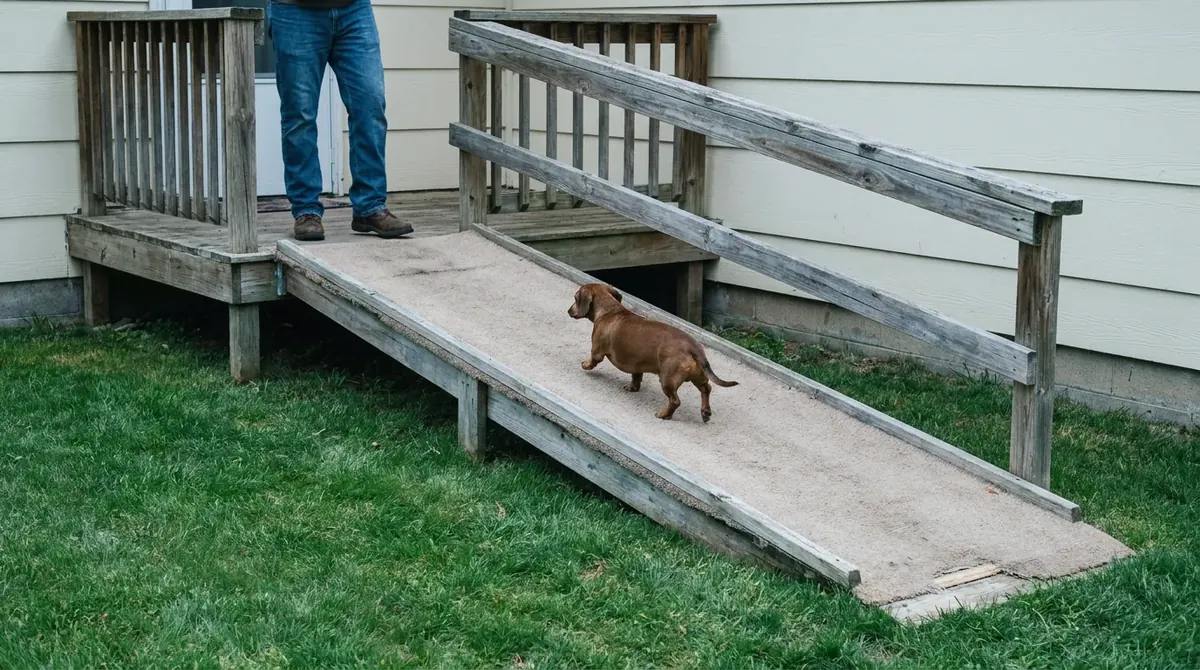
- Side rails along the entire ramp, since Ruff Ramp's manufacturer notes that few dogs will use a ramp that lacks them
- A raised rail at the bottom, which keeps an older dog's back legs from slipping off
- A grippy, non-slip surface, like carpet, rubber, or grooved plastic
- A base that is wider and sturdier for big dogs, who want that steadiness underfoot
Rail height counts as well. You gauge it from the floor to a spot midway between the collar bone and back. Ruff Ramp sells rails in four height ranges: 5 to 9 inches, 9 to 16 inches, 16 to 22 inches, and 22 to 28 inches.
The Ramp People recommends supervising your dog even when a ramp has safety edges, which help prevent stepping off the side.
Find the ramp length your dog needs
Questions We Hear Often
Do dogs find ramps easier than stairs?
With a gentle grade, yes. PetMD finds ramps easier on the joints and prefers a ramp to steps when a dog has arthritis or back trouble. Long-backed breeds like dachshunds and corgis risk back injury from tiny, repeated jolts, and a ramp takes those jolts away.
Can a big dog use a ramp on stairs?
Yes. PetMD says ramps suit larger dogs well, and a bigger dog will feel steadier on a wider, sturdier base. Length is the sticking point, because a heavy dog going up a full flight still requires a long run at a safe grade.
What if my dog refuses the ramp?
If a ramp isn't working for your dog, PetMD suggests trying another option with grip pads to help prevent sliding. A lift harness or a stair carrier can also lend a hand.
Can a ramp be stored away when it is not needed?
Plenty of ramps fold up. PetMD points out they tend to be easier to move around than dog steps, and some fold down flat enough to tuck beneath a bed or couch.
If a full flight is the problem, send the short form today. A local installer will measure your actual stairs and quote a lift or built ramp that fits your home and your dog.