
Carrying Your Dog on the Stairs: Which Carrier Fits
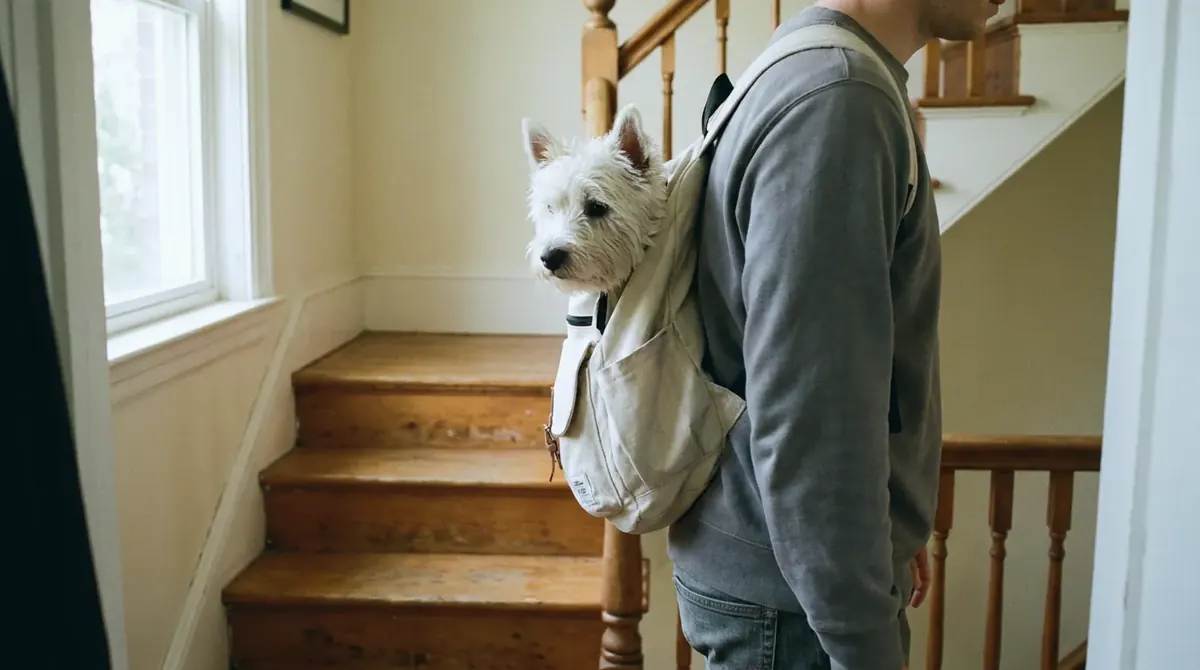
A dog carrier for stairs works best for small and medium dogs, and your dog's weight is really the deciding factor. Since backpack and front carriers come in weight bands, start by weighing your dog, then match that number to the right band.
Carrier Sizes by Weight
No carrier fits every dog: each one is built for a specific weight range. K9 Sport Sack, for instance, publishes bands of 5 to 25 lb, 25 to 40 lb, and 40+ lb on its site. Ruffwear, another manufacturer, says its Hitch Hiker backpack carrier comfortably holds dogs up to 40 lb.
| Your dog's weight | A good fit |
|---|---|
| 25 lb or less | A small front pack or backpack carrier rated for that range |
| 25 to 40 lb | A bigger backpack carrier made for this band |
| More than 40 lb | One company offers a 40+ lb carrier, though a lift harness is often simpler on stairs |
With a carrier, both your hands stay free for the stair rail: a real plus when you're climbing with a dog strapped to you. The K9 Sport Sack Air pack, for reference, sells for $99.95.
Dogs That Gain the Most From Being Carried
A few breeds are built with fragile backs. Dachshunds and corgis are especially prone to back trouble, and the little jolts of jumping down steps add up over the years. Picking these dogs up saves their spines from all those little shocks.
Holding a Small Dog in Your Arms
A small dog can travel safely in your arms, as long as you use the right hold. A guide to helping senior dogs on stairs shows a hold that cradles the whole body:
- Slide an arm beneath the chest, just back of the front legs, so the front half is supported.
- Cup your other arm under the hindquarters (rear and hind legs together) so the back half doesn't droop.
- Hug the dog close to your chest; that steadies it and keeps it under control.
- Take the steps slowly, one at a time, to stay balanced.
- Heading down, grip the dog firmly so it can't push off and leap out of your arms.
Never lift a dog by the front legs, by the collar, or by the scruff of loose skin at the neck. That kind of lift can hurt the dog and won't safely bear its weight.
Options for Dogs Over 40 Pounds
The same stairs guide calls a large dog a two-person job. If you're alone, a rear sling supports the back half while the dog walks along on its front legs.
A lift harness works similarly, with sizes matched to how much your dog weighs. The Help 'Em Up Harness is one example, sold in these sizes:
| Size | Fits dogs of |
|---|---|
| X-Small | 10–25 lb |
| Small | 25–45 lb |
| Medium | 45–80 lb |
| Large | 80–125 lb |
| X-Large | 125–225 lb |
Prices start at $80.00 for the smallest size, the manual says. If you want more detail on fitting and using one, see our page on lift harnesses for stairs.
Does a Dog Stair Lift Exist?
Yes. The PAW LIFT works like this: a padded box glides along a rail fitted beside your staircase. According to the manufacturer, the box has been weight tested to carry as much as 75 lb, and the unit runs $12,950. Compared with a carrier or harness, that's a lot of money, so it mostly makes sense for a dog that cannot manage stairs at all for the long term. For more on powered options, see our page on dog stair elevators.
Or Try a Ramp
With a ramp, your dog can go up and down under its own power, but a ramp eats more room than you'd think. Laid straight along a normal staircase, a ramp matches the stairs' slope of about 30 to 35 degrees: steeper than the 18 to 25 degrees most dogs are comfortable with.
For three steps, a gently sloped ramp suited to an older or small dog runs about 6 ft 4 in long. Thirteen steps at that same gentle slope, though, would call for something on the order of 27 ft 3 in of ramp: one reason ramps shine on short flights, not full staircases. Want numbers for your own steps? Our ramp length finder does the math, and our page on ramps for dogs on stairs goes deeper.
Matching the Method to Your Dog
If your dog weighs less than 25 lb, a little carrier (or a careful cradle in both arms) is usually all you need. Dogs in the 25 to 40 lb range generally suit a larger backpack carrier, while heavier dogs do better with a harness or sling, or an extra person to share the load. When fear is behind it, our page on dogs scared of stairs can help; when it's simply age, see helping an old dog with stairs.