
How to Help Your Dog Up the Stairs With a Lift Harness
A lift harness for the stairs lets your dog climb with its own paws while you grip the handles on its back and carry some of the weight yourself. Older dogs often benefit from this, since weakness, muscle loss, and trouble with balance can make steps feel risky.
Picking a Harness for Stair Use
Which kind suits your dog depends on where it needs support. Both Walkin' Pets and Wagisk cover these basic styles:
- Front lifting harness: supports the chest from below, for a dog whose front legs are weak.
- Rear lifting harness: holds up the hind end beneath the belly or back legs, for a dog with weak or paralyzed back limbs.
- Under-belly sling: a padded strap that runs under the belly with handles above, handy for a quick trip up a short flight.
- Full-body lifting harness: holds both ends of the dog, for dogs that need support front and back, or for daily use over months or years.
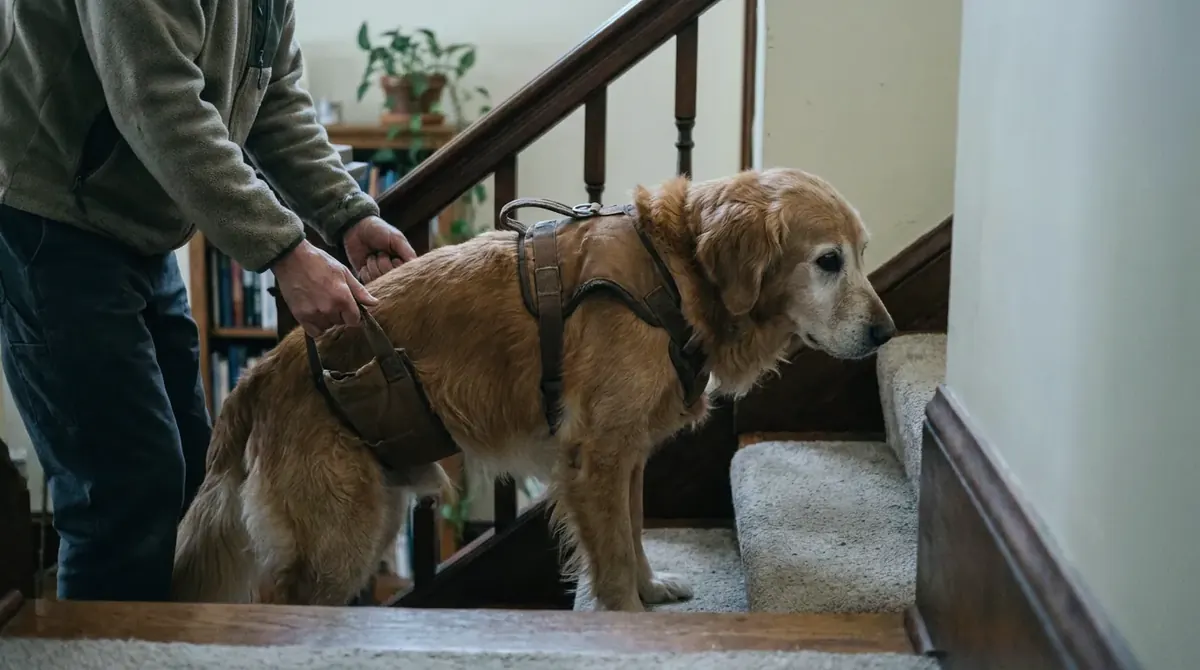
Help 'Em Up makes a full-body harness that spreads the dog's weight evenly, so you can raise the front and rear together. Its front handle has a T-shaped pad that sits under the breastbone.
Harness Sizes and Prices
Sizing for these harnesses goes by how much your dog weighs. Here are the sizes and prices Help 'Em Up lists.
| Size | Weight of the dog | Cost |
|---|---|---|
| Extra small | 10 to 25 pounds | $80 |
| Small | 25 to 45 pounds | $95 |
| Medium | 45 to 80 pounds | $110 |
| Large | 80 to 125 pounds | $125 |
| Extra large | 125 to 225 pounds | $140 |
Each brand has its own size chart, so look at the chart for whatever harness you are considering.
Fitting the Harness
A good fit means you can slide two fingers between the strap and your dog. Check the fit before you try the stairs.
The handles should be adjustable, so you can support your dog without stooping or hurting your back.
The Help 'Em Up model has walking loop handles that adjust in two ways: lengthwise, to support the body from end to end, or crosswise, to help only the front shoulders or only the rear hips.
Walking the Stairs With the Harness
Give your dog time to accept the harness before you ask it to trust you on the stairs.
- Start with short walks in the harness so the feel becomes familiar.
- When your dog is at ease, keep it on longer, and then bring it to the stairs.
- On the first lift, pause a moment so your dog feels the support before you move a foot.
- Grip the handle to add a boost and to keep your dog from slipping.
- Climb one step at a time.
- On the way down, keep a firm hold so your dog cannot leap ahead of you.
Never pick a dog up by the front legs, the collar, or the scruff of its neck. Two people should share the lift for a large dog. A rear sling is one more choice, because your dog keeps stepping with its front limbs while you carry the hind end.
Will a Towel Do the Job?
For a little while, a towel under the belly can help. After TPLO, an operation on the knee to repair a torn ligament, a sling or belly towel helps stop slips and falls on stairs. But a towel is awkward to grip and prone to slipping, so a harness or sling with handles works better for everyday use.
Common Questions
Which harness is best for carrying my dog up the stairs?
A full-body lifting harness supports both ends of your dog, and Help 'Em Up says its harness lets you lift the front and back together. If you need to carry a small dog, put one arm under its chest just behind the front legs and the other under its rear end, and hold it close to your body.
How do I help my senior dog go up and down stairs?
Be there every time your dog uses the stairs, and reach for a support sling on its weaker days. Block the stairs with a gate when you are out, so your dog cannot attempt them unsupervised. Also watch for a dog that speeds up on the descent, because a senior that gains speed downhill may not be fully in control.
How do I know which size my dog needs?
Put your dog on the scale, then check the manufacturer's chart for its weight. If your dog sits between two sizes, Help 'Em Up recommends the smaller of the two.
Do these harnesses work for dogs with weak hind limbs?
Yes. A rear harness or rear sling carries weight off the back limbs while your dog walks on its front legs. With Help 'Em Up, the rear section, named the Hip Lift, must attach to the front piece to stay put. Used alone, it can slide off.
Where should I stand when my dog takes the stairs?
Stay at your dog's side and hold the handle. Use the handle to give support and help prevent slipping, taking one step at a time. Slings and other mobility aids are made to support a dog on the stairs, and walking beside your dog keeps the handle right where you need it.